
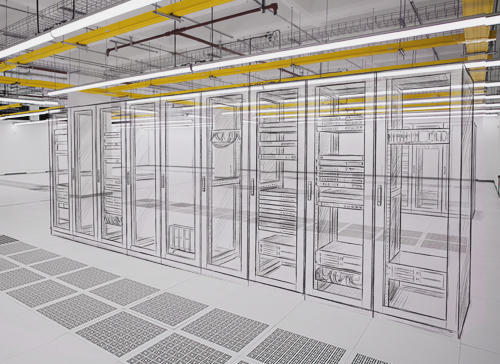
A company planning to add a few racks next year might assume finding space will be relatively straightforward. Find a data center, reserve the racks, order the hardware, and schedule the deployment.
But there’s quite a bit more to consider.
A facility might have available floor space without enough power or cooling capacity for your equipment. The carriers you need might not be available, or the facility might have limited room for expansion.
And with data center availability at historic lows across North America, companies are having to think further ahead about their infrastructure needs.
Data Center Availability Is Already Tight
According to JLL’s Midyear 2026 North America Data Center Report, data center vacancy has remained at just 1% for three consecutive years.
Even more telling, North America has 66 gigawatts of data center capacity under construction, with 95% of that capacity already committed. JLL reports that many tenants securing space in 2026 are contracting for delivery in 2028.
Much of that demand comes from hyperscalers, AI companies, and neocloud providers securing enormous amounts of infrastructure. Hyperscalers alone account for 59% of tenant demand in JLL’s report.
The situation is different for a business looking to deploy a few colocation racks. Smaller deployments don’t face exactly the same capacity requirements or lead times.
Still, there are consequences throughout the market. Available capacity is increasingly fragmented, and power availability has become one of the biggest considerations in choosing a data center.
Even enterprises requiring between 500 kW and 3 MW are having trouble securing capacity in certain markets.
For companies planning infrastructure expansions, it’s worth understanding what’s available well before the equipment is ready to install.
Capacity Planning Goes Beyond Rack Space
Data center capacity planning involves forecasting the space, power, cooling, and connectivity your infrastructure will require, both today and as it grows.
Rack count is usually the easiest part to estimate. The other requirements can be more complicated.
Consider power density. Five racks of conventional enterprise servers will have very different requirements from five racks running high-performance computing or GPU workloads. The same applies to cooling capacity and how power is distributed throughout the facility.
Connectivity also deserves attention. A facility might support dozens of carriers, but you still need to confirm the specific providers, network paths, and cross-connects your deployment requires.
Then there’s future growth.
If you’re deploying three racks today but expect to double that footprint in two years, it’s worth knowing whether the additional capacity will actually be available. You also need to understand what happens if your power requirements increase faster than your rack count.
These considerations affect cost, performance, and how easily your infrastructure can expand.
Work Backward From Your Deployment Date
There’s no universal timeline for deploying colocation infrastructure. A few standard racks in an existing data center can move relatively quickly. A private cage, a high-density GPU environment, or a larger multi-site deployment may require considerably more planning.
The best place to start is with the date your infrastructure needs to be operational.
Start with your expected growth. Estimate how much compute capacity, power, and rack space you’ll need over the next several years. Factor in geographic requirements, network connectivity, compliance, and any workloads you expect to introduce.
Evaluate providers before committing. Confirm how much power and space is available today, what expansion capacity exists, and whether the facility can support your equipment’s density. It’s especially important to distinguish between infrastructure that’s currently operational and capacity that’s still under development.
Account for equipment and installation timelines. Hardware procurement, network circuits, cross-connects, and other components may take longer than expected. These timelines should be coordinated with the data center provider rather than handled independently.
Test before going live. Network connectivity, failover, replication, backups, monitoring, and remote access should all be validated before production workloads are moved.
And once the deployment is running, continue monitoring utilization against your original forecast. If demand is growing faster than anticipated, you want to identify that trend while you still have expansion options.
For businesses planning multiple locations, this process should also account for geographic redundancy and how workloads will operate across facilities. We’ve covered that in more detail in our guide to multi-region infrastructure.
How far in advance should you plan a colocation deployment?
Colocation deployment timelines vary depending on rack count, power density, network requirements, and available facility capacity. Standard deployments may take weeks or months, while larger or more specialized environments can require planning a year or more in advance. Companies should evaluate available power and expansion capacity before setting a deployment date.
HostDime’s Expansion in Orlando
We’ve experienced these same capacity considerations firsthand.
HostDime’s existing Orlando data center has been approaching capacity, which is one reason we began developing SuperNova, our new purpose-built data center and global headquarters in Central Florida.
The seven-story, 100,000-square-foot facility includes three dedicated data center floors and capacity for more than 1,000 racks. It’s currently in the final stages of construction, commissioning, and facility preparation ahead of opening.
Planning for SuperNova began years before that capacity would be needed. Its electrical infrastructure, cooling systems, redundant network connectivity, equipment access, and future expansion requirements were all considered during the design process.
That kind of forward planning matters at every scale. Whether you’re developing an entire facility or reserving a private cage inside one, the decisions you make today will affect how easily you can expand later.
Start Planning Before Capacity Becomes a Problem
Most companies don’t need to reserve data center space years in advance. But waiting until a deployment becomes urgent can limit your options, particularly when power, cooling, and connectivity requirements get more complicated.
If you’re expecting to add racks, expand into another market, or increase the density of your existing infrastructure, start evaluating your requirements early. Having a clear understanding of your future needs makes it easier to compare providers and avoid expensive changes down the road.
HostDime’s SuperNova data center in Orlando was designed with future expansion in mind, offering enterprise colocation, private infrastructure, and carrier-neutral connectivity.