
Nearly one-third of cloud spend may be going to waste.
Flexera’s 2026 State of the Cloud Report found that estimated wasted cloud spend reached 29%, while 85% of organizations said managing cloud spend remains a top challenge.
That should sound familiar to a lot of infrastructure teams.
Hyperscale cloud made infrastructure easier to consume. Teams could deploy quickly, scale on demand, and avoid buying hardware before they knew what their systems needed. For early-stage products, variable workloads, and fast-moving development teams, that model makes sense.
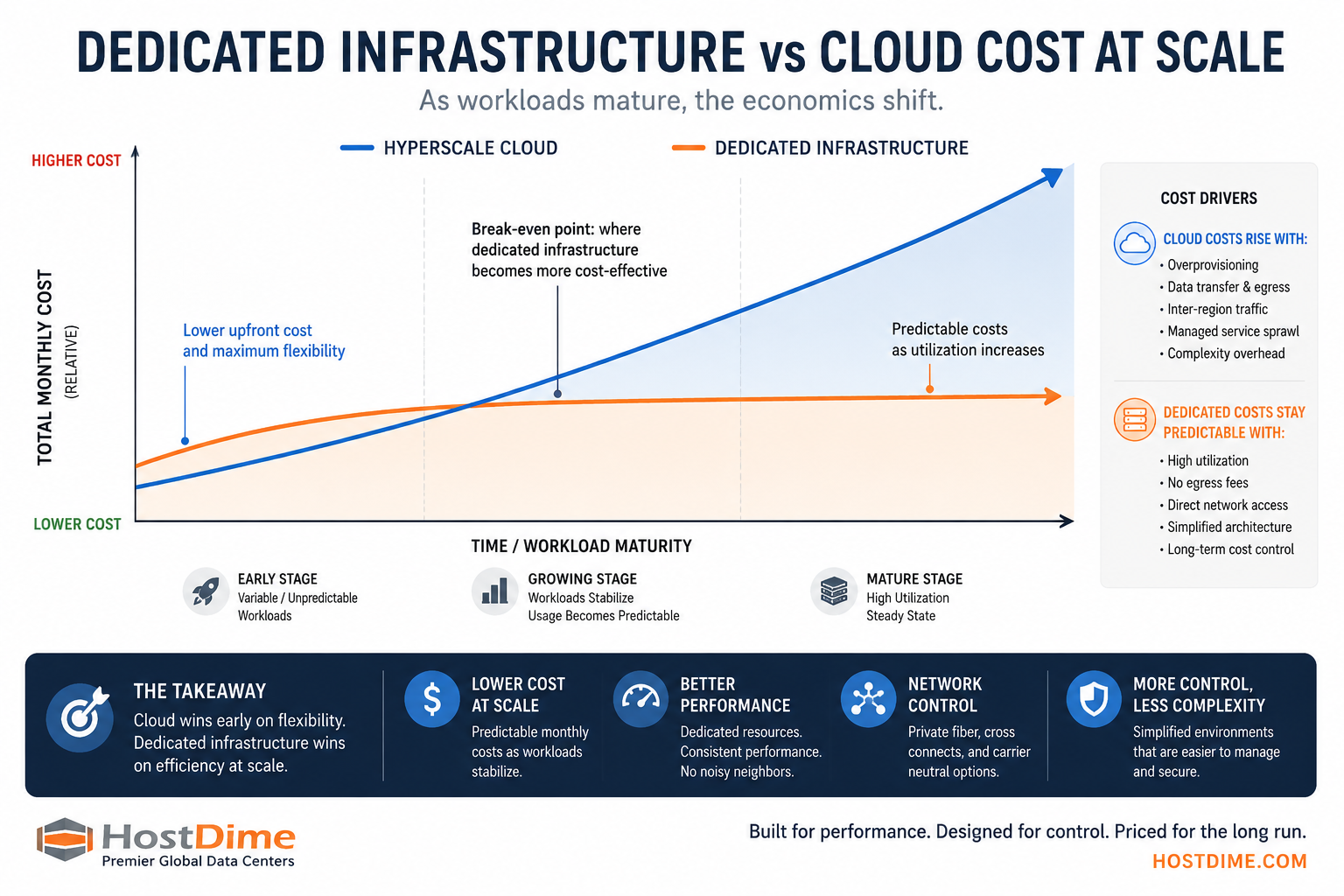
But the economics change as systems mature.
Workloads become predictable. Usage patterns stabilize. Data volumes grow. Performance requirements become more specific. At that point, infrastructure stops being mostly about speed of deployment.
It becomes a question of long-term operating cost. That is where many organizations begin comparing dedicated infrastructure vs cloud.
Where Cloud Costs Start to Shift
Cloud is priced around flexibility.
Organizations pay for fast provisioning, elastic capacity, and managed services wrapped inside a consumption-based model. That flexibility has value when demand is uncertain.
Cloud works especially well for:
- early product development
- burst capacity
- temporary workloads
- testing environments
- unpredictable traffic
However, when an application runs at a consistent level every month, the value of elasticity starts to decline. The organization may still be paying for a model built around rapid change, even though the workload itself has become stable.
The Costs That Usually Get Overlooked
Compute gets most of the attention, but it is rarely the full story.
Data movement can become a major cost driver. Outbound transfer, inter-region traffic, and service-to-service communication all affect the final bill. AWS, for example, treats data transfer out as its own pricing category, separate from the base cost of compute.
Overprovisioning adds another layer. Teams often size cloud environments around peak usage, redundancy, or worst-case performance. That can create extra capacity that sits idle most of the month.
Complexity has a cost too. The more services a team adds, the more time they spend managing configurations, access controls, alerts, dependencies, and cost controls. That work may not appear on the invoice, but it still consumes engineering time.
This is why cloud cost management has become such a major issue. Going back to Flexera’s State of the Cloud Report, 84% of respondents considered managing cloud spend their top cloud challenge.
Real Companies Have Already Done the Math
This is not just theoretical.
37signals, the company behind Basecamp and HEY, publicly documented its cloud exit. The company said its cloud bill dropped from a $3.2 million annual run rate to $1.3 million, with projected savings of more than $10 million over five years.
Dropbox showed a similar pattern at a much larger scale. In its S-1 filing, Dropbox said its infrastructure optimization lowered infrastructure costs by $39.5 million in 2016 and another $35.1 million in 2017. During that same period, gross margin improved from 33% in 2015 to 54% in 2016 and 67% in 2017.
Those examples do not mean every company should leave the cloud.
They show something more specific: once workloads are predictable and infrastructure scale is large enough, dedicated environments can materially change the cost structure.
Why Dedicated Infrastructure Changes the Math
Dedicated infrastructure works from a different economic model.
Instead of paying for resources as they are consumed, organizations deploy dedicated servers, colocation environments, and/or private infrastructure with a more predictable monthly cost.
That predictability matters when usage is known.
A stable database, high-traffic SaaS platform, gaming environment, media workload, AI application, or compute-heavy system may not need constant elasticity. It may need consistent performance, direct access to hardware resources, and a cost model that can be planned around.
When servers, racks, or private environments are kept highly utilized, the cost per workload can become more efficient over time.
Where HostDime Fits
HostDime helps organizations build infrastructure around how their workloads actually run.
For teams with stable, performance-sensitive, or cost-sensitive systems, HostDime offers dedicated bare metal compute, high-density colocation, private cloud, managed services, private fiber, cross connects, and carrier-neutral interconnection across multiple global regions.
That gives infrastructure teams more control over performance, network design, and cost predictability without taking on every operational responsibility themselves.
Cloud still has a role in modern infrastructure. It remains useful for experimentation, burst capacity, and workloads with unpredictable demand.
As workloads stabilize, teams need infrastructure that aligns with their actual usage patterns. Dedicated infrastructure gives organizations a way to reduce cost volatility, improve performance consistency, and build environments designed for long-term growth.
If your infrastructure costs are rising while your workloads have become predictable, it may be time to rethink where those workloads live.
Talk with HostDime’s infrastructure team to explore dedicated infrastructure, colocation, and hybrid deployment options built around your performance and cost requirements.