
Latency is usually blamed on servers.
Teams add more CPU, memory, and resources hoping to improve performance. But many of the worst bottlenecks have nothing to do with compute. They live in the path between systems. As infrastructure becomes more distributed, that path influences performance just as much as the hardware running on either end. Increasingly, the answer isn’t another server. It’s better connectivity.
Modern applications depend on databases, storage, cloud platforms, carriers, and users spread across multiple environments. Every additional hop adds distance, complexity, and latency. For AI platforms, SaaS applications, streaming services, financial systems, and gaming environments, those milliseconds matter, and they’re increasingly won or lost on the network, not the rack.
Why Network Architecture Matters
The public internet is incredibly resilient, but it wasn’t built for predictable performance.
Traffic may traverse multiple providers before reaching its destination. Routes change and congestion happens, causing latency to creep up.
As environments become more distributed, many organizations spend heavily optimizing compute while overlooking the network paths connecting their workloads. Reducing distance, eliminating unnecessary hops, and creating direct connections can deliver meaningful gains in both latency and reliability.
What Is Private Fiber?
Private fiber is dedicated fiber-optic connectivity that links facilities, applications, and environments directly, without routing traffic across the shared, unpredictable paths of the public internet.
Instead of depending entirely on public routes, organizations using private fiber get a predictable, controlled path for their data to travel. That control is the whole point: you’re no longer at the mercy of someone else’s congestion or someone else’s routing decisions.
Private fiber delivers:
- Lower latency
- Consistent network performance
- Improved redundancy
- Greater routing flexibility
- Enhanced security
For organizations operating across multiple locations, private fiber should be a part of your core infrastructure.
Private Fiber vs. the Public Internet
| Public Internet | Private Fiber | |
|---|---|---|
| Latency | Variable, hop-dependent | Low and predictable |
| Routing | Subject to provider changes, congestion | Fixed, dedicated path |
| Security | Shared infrastructure | Isolated, dedicated connection |
| Reliability | Best-effort | Built for consistency and redundancy |
| Control | Limited | High — organization-defined paths |
This is the trade-off in plain terms: the public internet is cheap and ubiquitous, but it optimizes for reach. Private fiber optimizes for a path you can count on.
How Cross Connects Reduce Latency
If private fiber solves distance between locations, cross connects solve distance within a facility, and some of the shortest connections deliver the biggest gains.
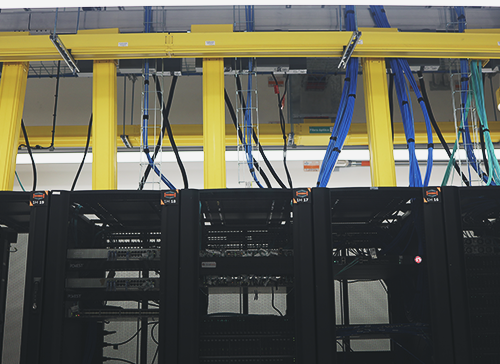
A cross connect is a direct physical connection between customers, carriers, cloud providers, and networks within the same data center. Rather than sending traffic out across external networks, systems communicate over short, dedicated paths measured in feet instead of miles.
This results in fewer network hops, reduced transit costs, and greater reliability. For many applications, proximity matters as much as bandwidth. Cross connects bring that proximity inside the data center itself.
Carrier Neutrality Creates Flexibility
Private fiber and cross connects are most valuable when they’re not locked to a single provider. That’s where carrier-neutral data centers come in.
Unlike facilities tied to one carrier, carrier-neutral environments let organizations choose among multiple carriers, establish direct peering relationships, and adapt as requirements change.
Organizations gain:
- More carrier choices
- Improved routing flexibility
- Better pricing through competition
- Easier failover and resiliency
- Direct access to interconnection ecosystems
Infrastructure no longer has to be locked to a single network provider’s roadmap or pricing.
Internet Exchanges Keep Traffic Local
Internet Exchange Points (IXPs) are becoming increasingly important as applications and workloads grow. IXPs let networks exchange traffic directly without relying on distant transit providers — keeping traffic local, shortening routes, and reducing both latency and cost.
HostDime facilities are home to multiple Internet Exchanges, including:
- GDL-IX in Guadalajara, Mexico
- PITT-IX.br in João Pessoa, Brazil
- PIT-IX in Bogotá, Colombia
- CFL-IX in Orlando, Florida
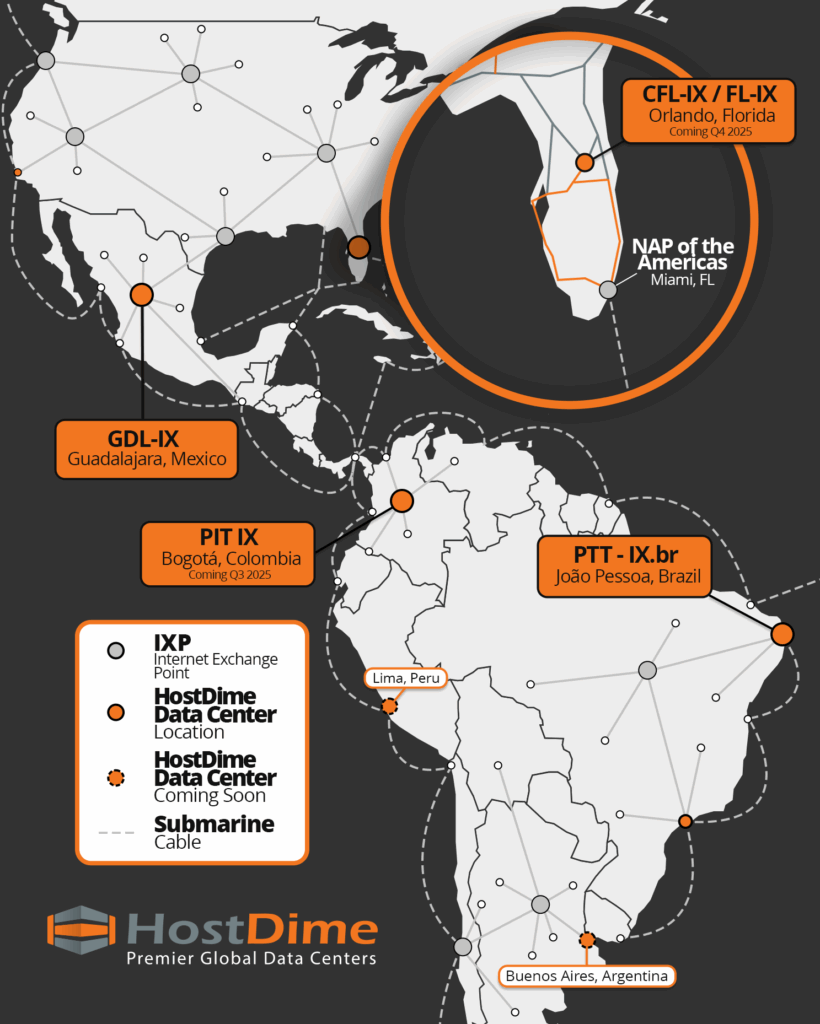
These exchanges create local ecosystems where carriers, ISPs, cloud providers, and enterprises exchange traffic more efficiently. Keeping traffic local reduces unnecessary hops and gives organizations greater control over network performance.
HostDime’s Private Fiber Footprint
HostDime’s carrier-neutral, purpose built facilities were built around interconnection from the ground up. That means interconnection is foundational to how the facilities are designed.
Across HostDime’s footprint, organizations gain access to more than 50 carriers, on-site cross connects, dark fiber transport, and Internet Exchanges in markets including Mexico, Brazil, Colombia, and Orlando. These interconnection options allow teams to create direct paths between networks and optimize traffic flows around their specific requirements.
Private Fiber FAQ
What is private fiber? Private fiber is dedicated fiber-optic connectivity between two points — a facility, a cloud provider, a partner network — that doesn’t share capacity or routing with general public internet traffic.
How is private fiber different from a cross connect? A cross connect is a private fiber connection within a single facility, linking two parties in the same building over a few feet of cable. Think of a cross connect as private fiber at its shortest, most local scale.
Who actually needs private fiber? Any organization where milliseconds affect revenue or experience — AI/ML platforms, SaaS providers, streaming services, financial trading systems, gaming infrastructure — along with any business running multi-site or hybrid-cloud architectures that need predictable performance between locations.
Does private fiber replace the public internet entirely? No. Most organizations use a hybrid approach: private fiber and cross connects for latency-sensitive or high-volume paths, public internet for everything else.
Distance Shapes Performance
The distance between systems influences performance just as much as the systems themselves.
As applications become more distributed, physical proximity and interconnection have become fundamental parts of infrastructure design. Private fiber, cross connects, carrier-neutral facilities, and local Internet Exchanges all play a role in creating faster, more predictable infrastructure.
Whether you’re connecting cloud environments, multiple facilities, or latency-sensitive applications, our team can help design the right interconnection strategy. Open a chat at hostdime.com to get started.