
For a long time the conversation around infrastructure was framed as a choice. Either you ran your systems in a public cloud environment, or you operated your own hardware in a data center. In practice, most mature platforms no longer treat infrastructure as a binary decision. They treat it as a stack of environments that serve different roles.
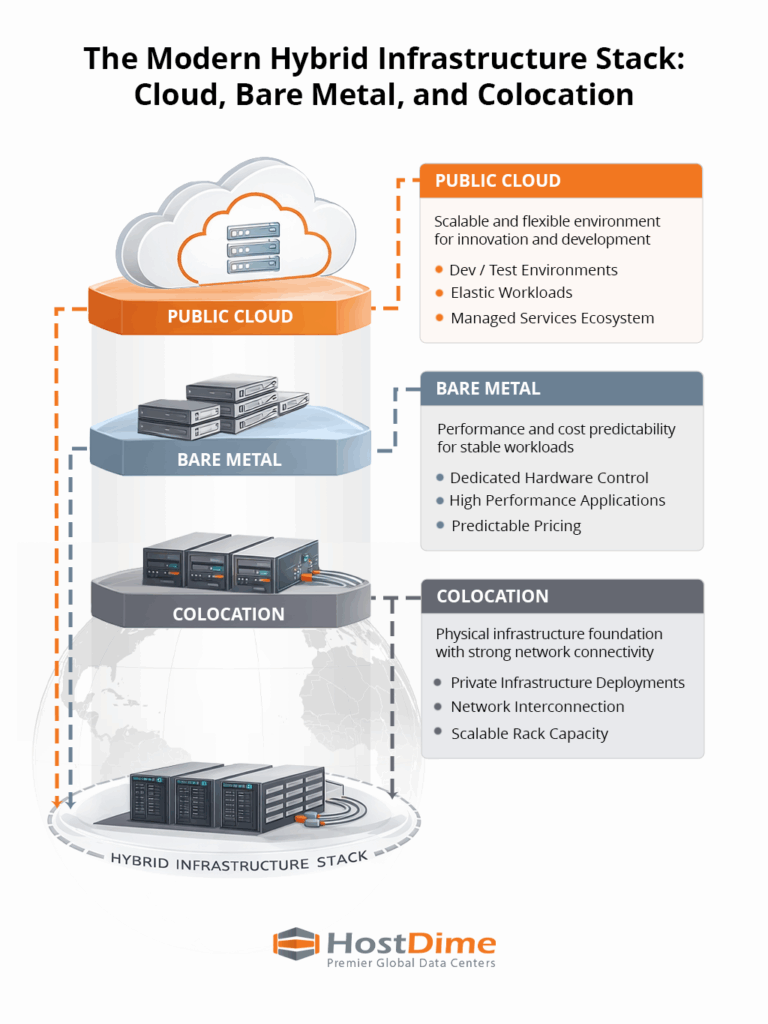
Today’s infrastructure architecture often combines three layers: public cloud, dedicated compute such as bare metal, and colocated hardware inside professional data centers. Each environment solves a different operational problem. The companies that scale successfully are usually the ones that learn how to combine them intelligently.
Understanding how these pieces fit together is becoming a core responsibility for infrastructure and platform teams.
Why Single Environment Infrastructure Breaks Down
Early stage companies often run entirely in the public cloud. The advantages are obvious. Cloud infrastructure allows teams to deploy quickly without purchasing hardware, managing facilities, or planning long-term capacity. It is a powerful environment for experimentation and early growth.
As workloads mature, the economics and operational characteristics of cloud environments begin to change. Predictable workloads can become expensive when billed on a consumption model. High performance applications may require more control over hardware and networking than shared environments provide. Latency considerations begin to shape architectural decisions.
At the same time, running everything on self-managed hardware introduces its own challenges. Facilities, power, cooling, connectivity, and physical security are complex responsibilities that few organizations want to manage internally.
This is where hybrid infrastructure emerges. Instead of forcing workloads into a single environment, organizations place each workload where it performs best.
The Role of Public Cloud in Hybrid Infrastructure
Public cloud remains an essential layer of modern infrastructure. Its greatest strength is flexibility. Teams can deploy new services quickly, scale applications during periods of uncertainty, and experiment with new architectures without committing to hardware.
Cloud environments are often ideal for development pipelines, temporary workloads, and applications with unpredictable demand patterns. They also provide access to large ecosystems of managed services that accelerate product development.
Many companies keep cloud environments as the “innovation layer” of their infrastructure. It allows them to move quickly while their more predictable workloads settle into environments that provide stronger cost control.
Why Bare Metal Is the Performance Layer
Dedicated compute becomes valuable once workloads reach a certain level of consistency. Bare metal servers provide full control over hardware resources without the overhead of virtualization layers or shared infrastructure.
For performance-sensitive applications, this control can make a significant difference. High performance databases, real-time platforms, and compute-heavy services benefit from running directly on dedicated hardware.
Bare metal also introduces cost predictability. Instead of paying for compute cycles as they are consumed, organizations can plan capacity around fixed hardware deployments. For many scaling platforms, this predictability becomes an important financial advantage.
Bare metal therefore often becomes the “performance layer” of a hybrid infrastructure stack.
Colocation as the Infrastructure Foundation
Colocation environments solve a different problem altogether. They allow organizations to operate their own infrastructure without managing the physical facility that supports it.
Inside a professional data center, companies gain access to redundant power systems, cooling infrastructure, physical security, and diverse network connectivity. Instead of building and maintaining these systems internally, organizations focus on operating the hardware that supports their applications.
Colocation becomes particularly valuable when infrastructure deployments begin to scale. Expanding server fleets, deploying racks of equipment, and building network connections between environments becomes much easier inside facilities designed specifically for that purpose.
In many hybrid architectures, colocation becomes the “infrastructure foundation” where dedicated compute and network systems live.
How the Hybrid Infrastructure Stack Works Together
When these three environments are combined thoughtfully, they allow infrastructure teams to optimize for both performance and flexibility.
A common pattern is to run development environments and rapidly changing services in the cloud, while migrating stable workloads onto dedicated compute infrastructure. Those servers often live inside colocation facilities where organizations can expand capacity and connect to multiple networks. Rather than replacing one another, these layers complement each other.
Infrastructure Environments That Support Hybrid Architectures
As organizations adopt hybrid infrastructure strategies, the environments that support these architectures become increasingly important.
Dedicated compute, network interconnection, and physical infrastructure must operate together in a way that allows platforms to scale without introducing operational complexity. Many companies therefore look for infrastructure providers that combine high-density colocation, dedicated compute environments, and strong network connectivity within the same facilities.
This approach allows teams to deploy bare metal workloads, expand rack capacity, and connect to cloud environments or private networks while keeping infrastructure centralized within a reliable physical environment.
HostDime’s global infrastructure footprint was built with this hybrid model in mind, combining colocation environments, dedicated compute resources, and strong interconnection capabilities across multiple regions. For organizations designing modern infrastructure stacks, this type of environment allows cloud, bare metal, and colocated systems to operate together as part of a cohesive architecture.