
Latency is often treated like a server problem.
Teams add more compute, tune applications, and optimize infrastructure, while the path between networks receives less attention. But for ISPs, CDNs, SaaS platforms, AI providers, gaming networks, and enterprises running distributed systems, network distance can influence performance just as much as the systems themselves.
That is where IXP colocation becomes valuable.
An Internet Exchange Point, or IXP, gives networks a physical place to connect and exchange traffic directly. When that IXP is hosted inside a carrier-neutral data center, organizations can place infrastructure closer to the networks they depend on, reduce unnecessary hops, and gain more control over how traffic moves.
For high-traffic and latency-sensitive environments, that can mean faster performance, lower transit costs, and a more resilient network strategy.
What is IXP Colocation?
IXP colocation means placing your network equipment or infrastructure inside a data center that hosts an Internet Exchange Point.
Instead of relying only on third-party transit providers to move traffic between networks, organizations can peer directly with other connected networks through the exchange.
Think of an IXP as a meeting point for internet traffic. Networks connect in one shared location, exchange data more directly, and avoid sending local traffic across longer or less efficient routes.
That shorter path can improve latency, routing efficiency, cost control, and regional performance.
For organizations moving large amounts of data, the location of the exchange matters. The closer your infrastructure is to the networks, carriers, and partners you need to reach, the more control you have over performance.
Why Colocate at an IXP Facility?
Colocating at an IXP facility brings infrastructure and network exchange into the same environment.
That proximity reduces friction.
Traffic can move directly between connected networks instead of traveling through distant upstream providers. For applications that depend on speed and consistency, fewer hops can make a measurable difference.
IXP colocation is especially useful for:
- Internet service providers
- Content delivery networks
- Cloud and GPU compute platforms
- SaaS and edge application providers
- Streaming and media platforms
- Gaming infrastructure
- Enterprises with high-availability systems
These organizations need more than rack space. They need access to the network ecosystems that support fast, reliable, and cost-efficient traffic exchange.
Faster: Reduce Network Latency
Every network hop adds distance and processing time.
When traffic has to move through multiple upstream providers before reaching its destination, latency increases. Routes may also change based on congestion, provider decisions, or network conditions outside your control.
IXPs help reduce that uncertainty by allowing networks to exchange traffic locally.
For latency-sensitive workloads, local peering can improve application responsiveness and create more predictable performance. This matters for real-time systems, streaming platforms, AI workloads, gaming environments, and user-facing applications where milliseconds affect experience.
Lower-Cost: Reduce Transit Dependence
Network performance is only part of the value.
Cost matters too.
Without direct peering, organizations may rely heavily on upstream transit providers. As traffic volume grows, those transit costs can become a meaningful part of the infrastructure bill.
An IXP gives networks an opportunity to exchange traffic directly with other participants. This can reduce dependence on paid transit routes and help keep local traffic local.
For high-volume platforms, the economics can improve as more traffic is exchanged directly.
More Control: Choose How Traffic Moves
Carrier-neutral IXP facilities give organizations more network flexibility.
Instead of being limited to one provider, customers can choose from multiple carriers, establish direct peering relationships, add redundant paths, and adapt as their requirements change.
That flexibility can help teams improve routing control, add network redundancy, reduce vendor lock-in, support multi-region infrastructure, and build private and hybrid network paths
In a carrier-neutral environment, infrastructure teams can design network paths around performance, cost, and redundancy instead of working within a single provider’s limitations.
Why Carrier-Neutral Data Centers Make IXPs Stronger
IXPs work best when many networks can connect easily.
Carrier-neutral data centers support that model by allowing multiple carriers, ISPs, cloud providers, CDNs, enterprises, and network operators to meet in the same facility.
That creates a stronger interconnection ecosystem.
The more networks available in one place, the more valuable the facility becomes for customers that need routing flexibility and direct access to partners.
Carrier neutrality also improves long-term optionality. If one provider stops fitting your requirements, you can add or switch connectivity options without moving your physical infrastructure.
HostDime’s Global IXP Ecosystem
HostDime’s purpose-built, carrier-neutral data centers are designed around interconnection.
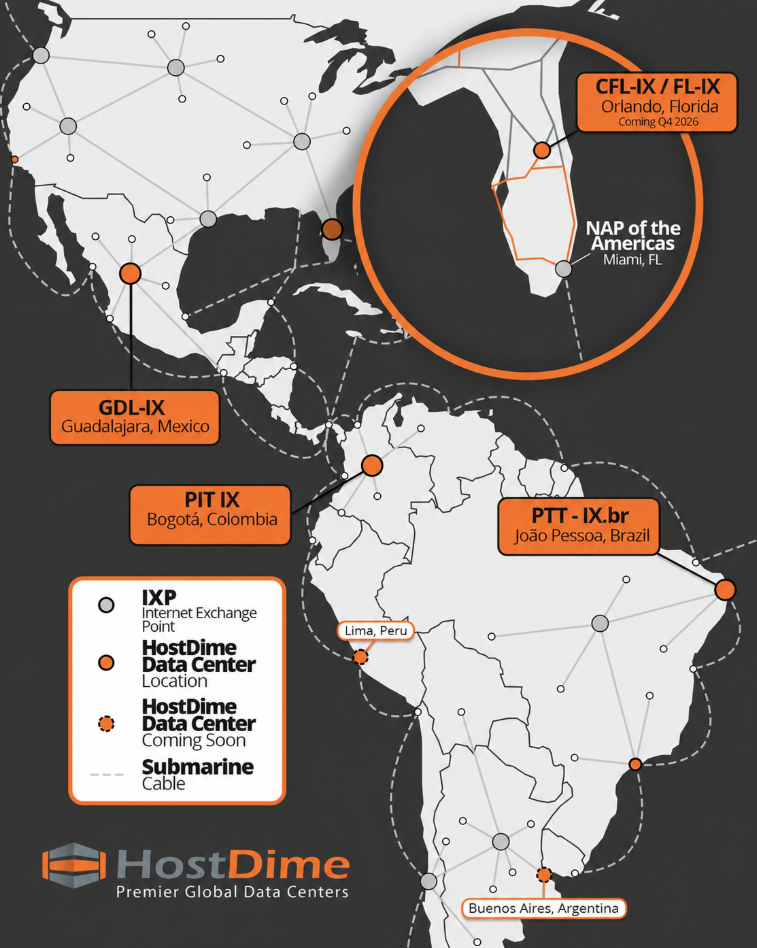
Across the United States and Latin America, HostDime provides access to Internet Exchange Points, global and regional carriers, cross connects, dark fiber transport, and private connectivity options.
-
GDL-IXP – Guadalajara, Mexico: The region’s first and only IXP. Keeps traffic local and speeds up delivery for ISPs, cloud platforms, and content providers.
- PTT-IX.br – Joao Pessoa, Brazil: Expanding interconnection to Brazil’s northeast coast, PITT-IX.br offers low-latency IXP colocation and reduces dependence on distant core exchanges.
- PIT IX – Bogotá, Colombia: A future interconnection hub for Colombia and northern South America, providing direct peering for ISPs and global carriers.
-
CFL-IX / FL-IX – Orlando, Florida (Q4 2026): HostDime’s new Tier IV data center will bring an IXP to Central Florida, reducing latency and boosting regional traffic efficiency.
HostDime’s Built-In Interconnection Advantages
IXP access is only one part of HostDime’s interconnection strategy.
HostDime’s facilities also provide:
- Access to 50+ global and regional carriers
- Carrier-neutral network options
- On-site cross connects
- Dark fiber connectivity to major hubs, including the Miami NAP of the Americas
- 1G and 10G private connectivity options
- Rooftop antenna rights for point-to-point microwave and GPS integration
- High-density colocation and dedicated infrastructure options
This gives customers the building blocks to design infrastructure around performance, redundancy, cost control, and regional reach.
Who Benefits from IXP Colocation?
IXP colocation is especially valuable for organizations where network performance affects customer experience, operational cost, or service reliability.
That includes:
- ISPs looking to exchange traffic locally
- CDNs delivering content closer to users
- SaaS platforms with regional users
- AI and GPU compute providers moving large datasets
- Streaming and gaming platforms
- Enterprises building resilient network infrastructure
- Edge application providers that need low-latency connectivity
For these organizations, infrastructure location becomes part of the network strategy.
Build Closer to the Networks That Matter
As applications become more distributed, infrastructure decisions are increasingly network decisions. Colocating at an IXP facility gives organizations a way to shorten traffic paths, reduce transit dependence, improve routing flexibility, and place infrastructure closer to the networks they need to reach.
HostDime’s carrier-neutral data centers were built for that kind of interconnection.
With IXPs, cross connects, private fiber, carrier access, dark fiber transport, and global infrastructure across strategic regional markets, HostDime helps organizations create faster, more efficient paths for their traffic.
The closer your infrastructure is to the networks it depends on, the better your environment performs.