
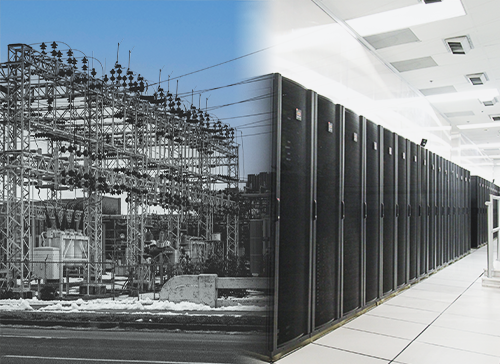
Data centers use a lot of electricity. With more facilities being built across the country, that has led to a fair question: What happens to the power grid when all these data centers come online? There’s more to the equation than how much electricity a facility uses.
A modern data center can be designed to reduce its demand when the grid is under the most pressure. At HostDime’s new SuperNova data center in Central Florida, we will participate in Duke Energy Florida’s interruptible service program, allowing Duke to disconnect the facility from the grid during high-demand events while SuperNova continues operating on its own generators.
Here’s how that works.
Why does electricity demand put pressure on the grid?
The amount of electricity people use changes throughout the day and throughout the year.
Usually, utilities have enough capacity to meet demand. The challenge comes during periods when millions of customers suddenly need more electricity at the same time.
Florida actually saw this recently. During an unusually cold stretch in February 2026, Duke Energy Florida asked customers to reduce electricity use during the morning hours because heaters were driving unusually high demand across the Southeast. Customers were encouraged to delay things like laundry, dishwashers, and EV charging until later in the day.
For a homeowner, that might mean waiting a few hours to run the dryer. A large data center can take a much bigger chunk of demand off the grid at once.
How can a data center reduce demand on the power grid?
Let’s use a simple example.
Say SuperNova is pulling 2 megawatts of power from Duke Energy on a cold morning when electricity demand across the region is unusually high.
Duke can call on SuperNova through its demand response program.
When that happens, SuperNova can disconnect from Duke’s grid and move onto its on-site generators. The data center keeps operating, but Duke suddenly has 2 megawatts less demand to serve.
For a utility trying to keep electricity supply and demand balanced across homes and businesses, removing a large load at the right time can help relieve pressure on the grid.
Why would Duke want SuperNova to disconnect?
There’s an immediate benefit: Duke has less demand to serve during the hours when the grid is under the most pressure.
There’s also a longer-term benefit.
Utilities have to plan enough generating capacity to handle the highest-demand periods of the year, even if those peaks only happen occasionally. Interruptible customers give Duke another option. If Duke knows it can temporarily remove large loads like SuperNova when needed, it can reduce or defer some of the additional capacity required to meet those peaks.
That’s the basic idea behind demand response: instead of only adding more power to the system, utilities can also work with large customers to temporarily reduce demand.
Duke Energy Florida’s own regulatory filings count these avoided generation-capacity costs as a benefit of its Interruptible Service demand-response program.
And that matters beyond Duke. New generation and other infrastructure can be expensive, and those costs are eventually reflected in the broader rate-setting process. Reducing or deferring some of that investment can help limit the system costs that ultimately affect end users.
Why does SuperNova have generators in the first place?
Because data centers need redundancy.
Businesses rely on the infrastructure inside SuperNova to stay online even if utility power is interrupted. That means the facility has substantial on-site generation capable of supporting its operations independently from the grid.
Most of the time, that infrastructure sits ready in case it is needed.
Through Duke Energy’s demand response program, that backup infrastructure can serve another purpose. During qualifying high-demand events, SuperNova can keep operating while temporarily removing its load from Duke’s grid.
Data centers are significant power users. That makes how they interact with the grid worth understanding.
SuperNova was designed to operate independently when necessary, and its participation in Duke Energy Florida’s interruptible service program gives the utility another way to manage demand during the moments when the grid is under the most pressure.
As Central Florida continues to grow, conversations about energy demand are going to continue too. Understanding how the infrastructure actually works is a good place to start.